🏛️ Forbidden City · Beijing
Forbidden City Guide: Tickets, Routes, and Everything to Know Before You Go
The Palace Museum is the single biggest reason most people come to Beijing — here's how to plan the visit so it actually lives up to the postcard.
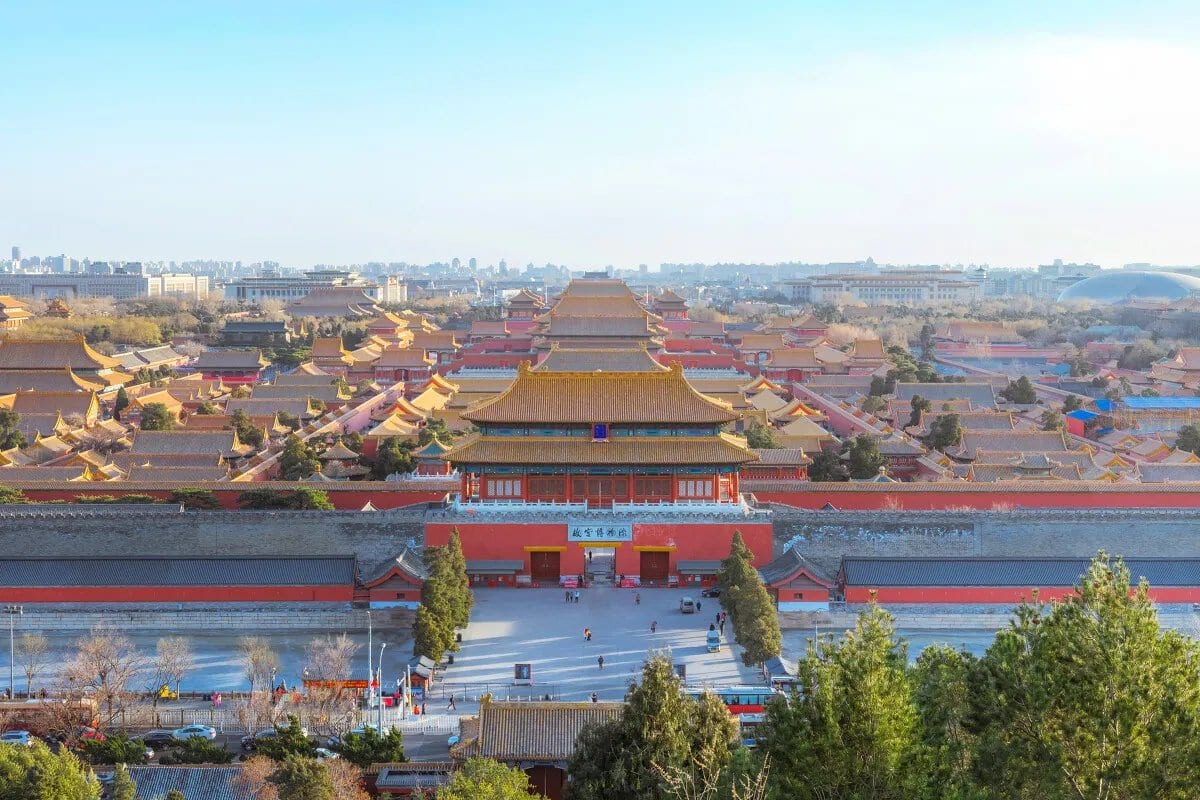
⚡ Quick Answer
You cannot buy a ticket on the day — the Palace Museum sells out 7 days ahead, and in peak season (Apr 1–Oct 31) tickets are ¥60 (¥40 off-season). Book online through the official Palace Museum website (foreigners register with their passport and pay by international card — no Chinese payment app required). The museum is closed every Monday (except public holidays). Book at 8 pm Beijing time, exactly 7 days before your visit — Golden Week slots disappear within minutes.
🤔 Is the Forbidden City Worth Visiting?
It's well worth a visit — it is a UNESCO World Heritage Site and the world's largest and best-preserved complex of wooden palace architecture. It once served as the residence and center of power for 24 emperors of the Ming and Qing dynasties. Behind the red walls and yellow tiles, and among the tiered palaces, lie 600 years of imperial history — from coronation ceremonies to life in the harem. In every corner, visitors can directly experience the grandeur of ancient Chinese royalty and the architectural ingenuity of the era. For foreign visitors, it is not merely "an old building," but a gateway to understanding Chinese history and culture — as you walk across the plaza of the Hall of Supreme Harmony, you will understand why the Chinese often say that the "Forbidden City" embodies the order and aesthetics of an entire empire.
🎫 How Much Are Forbidden City Tickets? (Official Prices and Booking)
The Forbidden City is one of the few places in China where the planning is almost as important as the visit itself. Here's everything you need to know, based on the museum's official ticketing rules.
From the Palace Museum's official ticketing policy:
| Item | Price | Notes |
|---|---|---|
| Main gate ticket (peak season, Apr 1–Oct 31) | ¥60 | Includes all main halls, excludes the Treasure Gallery and the Clock Gallery |
| Main gate ticket (off-season, Nov 1–Mar 31) | ¥40 | |
| Treasure Gallery (珍宝馆) | ¥10 | Worth it — houses the famous gold artifacts |
| Clock Gallery (钟表馆) | ¥10 | Also worth it |
| Senior discount (foreign visitors, age 60+) | ¥30 | All three of the above bundled into the discounted ticket |
| Student discount (foreign, age 7–17; undergraduates and below) | ¥20 | Same bundled access; bring a valid student ID |
| Children (foreign, age 6 and under) | Free | No ticket required |
Booking rules that will make or break your visit:
- 📅 Sale time: Tickets go on sale 7 days before your visit date at 20:00 (8 pm) Beijing time. They usually sell out within minutes — set an alarm.
- 🚫 No same-day tickets — the museum does not sell at the gate.
- 🛒 Where to book:
- Official Palace Museum website — register with your passport and pay by international card.
- Trip.com guided-tour package — bundles entry + English-speaking guide. Skip the booking race.
- 📘 Bring your passport. Register with your passport number and show the same passport at the gate.
- 🚪 Entry and exit: Enter at the Meridian Gate (午门, south) only. Exit via Gate of Divine Prowess (神武门, north) or East Glorious Gate (东华门).
- 🈚 Closed every Monday (except public holidays).
- 🕗 Hours: 8:30–17:00 (peak season, last entry 16:00); 8:30–16:30 off-season.
🧑🏫 With or Without a Guide?
If you want a deeper understanding of the history of the Forbidden City rather than just taking photos and checking it off your list, I highly recommend hiring a tour guide. The Forbidden City was the imperial palace of the Ming and Qing dynasties in China and has a history spanning more than 600 years. It is a masterpiece of ancient Chinese architecture and represents the pinnacle of traditional Chinese palace architecture. From its architectural heritage to its historical significance, they all need a professional tour guide to explain it to us. The guide turns the Forbidden City into a history lesson, not just a beautiful walk.
On your own, you'll only see the beautiful architecture but miss the even more fascinating stories behind it. You'll pass the marble balustrades carved with dragons, the bronze turtles and cranes in front of the main hall, the ten tiny beasts lined up on one particular roof — and probably not know what any of it means. That's the part most visitors tell themselves they'll research later, and never do.
👉 Want a guide? Trip.com bundles entry with an English-speaking guide — skip the booking race. Browse Forbidden City guided tours →
🙌 On your own? Book your ticket directly on the official Palace Museum website. Go to bookingticket.dpm.org.cn →
🗺️ Three Recommended Routes (From the Palace Museum's Official Visitor Map)
The Palace Museum publishes three routes inside its visitor map, one for each common time window. All three start at the Meridian Gate (午门, south) — the only entrance — and end at the Gate of Divine Prowess (神武门, north), directly across from Jingshan Park. Pick the version that matches how much time you have; the rest of the article assumes you are on one of them.
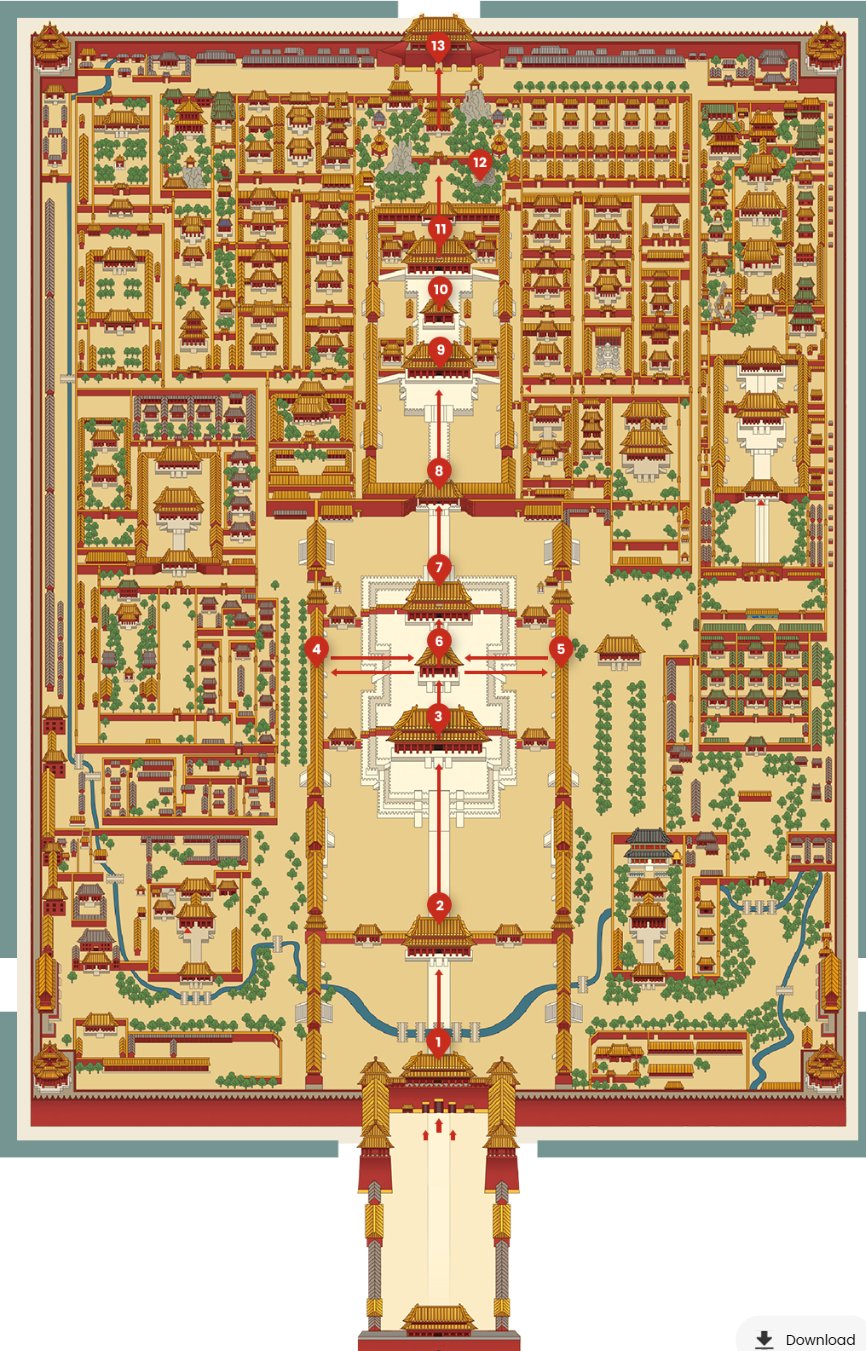
🏛️ Route A — Central Axis Only
The quick essentials. If you only came for the iconic photos and one or two great rooms, this is enough — it covers the entire central axis from south to north without a single detour into the side palaces. Almost every tour group walks this same spine, so expect company; the upside is you walk right past 600 years of imperial ceremony in two hours flat.
Here is the order, with the reason each stop earns its place:
- 午门 Meridian Gate — entry. Look up at the three-tiered tower as you walk through the low tunnel: the Ming emperors reviewed troops and announced the new year's calendar here, and the squeeze of the tunnel was deliberate. Everyone entered the emperor's presence as a small person.
- 太和门 Taihe Gate — the largest gate in the complex. Look at the bronze lions: left (male, paw on a ball = ruling the world), right (female, paw on a cub = raising the family).
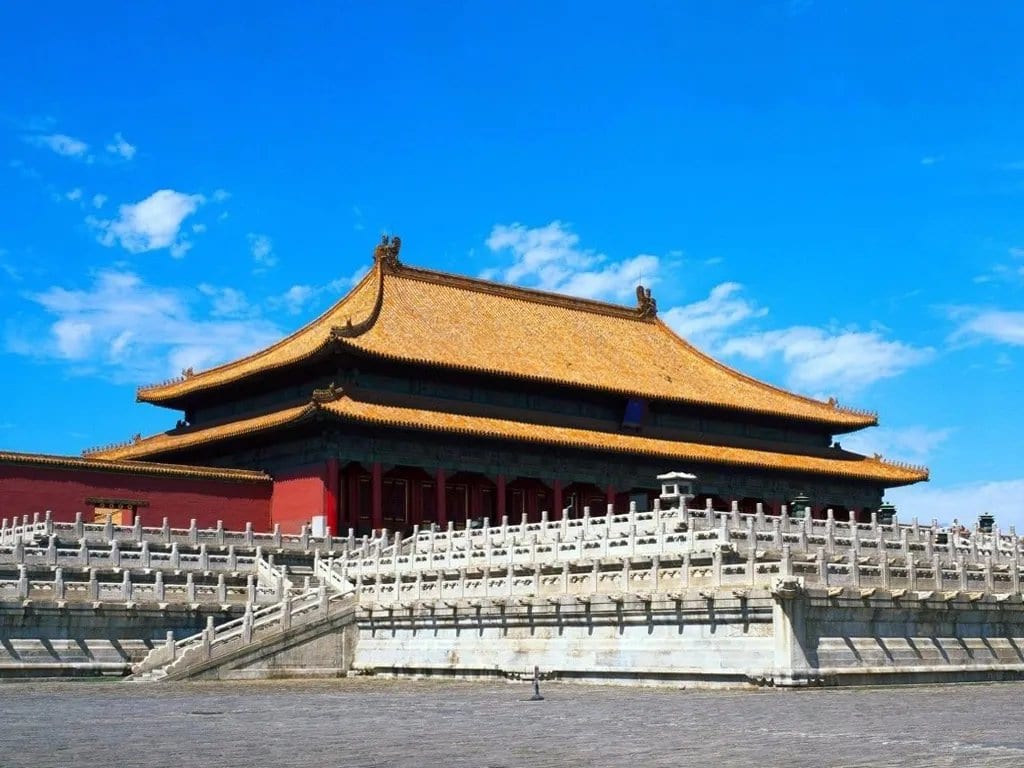
- 太和殿 Hall of Supreme Harmony — the largest wooden structure in China. Emperors were enthroned here, and the biggest state ceremonies happened on this plaza. The bronze turtles and cranes out front were incense burners, not decoration.
- 弘义阁 Hall of Righteousness — small west pavilion, built for minor court ceremonies. Almost no tourists.
- 体仁阁 Hall of Benevolence — matching east pavilion; together with #4, frames the great plaza, and it is the only spot to stand and take in the symmetry of the front court head-on.
- 中和殿 Hall of Central Harmony — easy to walk past, but the emperor rested and rehearsed here before the ceremonies at Taihe.
- 保和殿 Hall of Preserving Harmony — banquet hall, and from 1789 the fixed venue for the final stage of the imperial examination, where a scholar's entire career was decided in one sitting. Walk behind it for the "cloud and dragon" stone ramp: 12 craftsmen, 2 years.
- 乾清门 Gate of Heavenly Purity — crossing it marks the shift from public spectacle to private life; behind it, the scale of the architecture drops sharply.
- 乾清宫 Palace of Heavenly Purity — the emperors' bedroom through the Ming and into the early Qing; the Kangxi emperor was the last to actually sleep here, before his son moved the imperial household to the Hall of Mental Cultivation. Look for the 正大光明 plaque: from the Qing dynasty, the heir's name was sealed in a box behind it.
- 交泰殿 Hall of Union — small square hall between the two palaces, used for empress investitures and the imperial seals.
- 坤宁宫 Palace of Earthly Tranquility — the empress's residence through Ming and Qing, and where the emperor and empress spent their wedding night. Part of it was later converted into a shamanistic sacrificial hall, a Manchu tradition the Qing brought south with them — one building, two religions.
- 御花园 Imperial Garden — the back of the complex and your last stop. Rockeries shaped as mountains; pines over 400 years old.
- 神武门 Gate of Divine Prowess — exit. Cross the road straight into Jingshan Park (¥2), climb the hill and turn around: the whole Forbidden City spreads out below in gold tile — the single best photo in Beijing.
🏛️ Route B — Half-Day (Adds West Side)
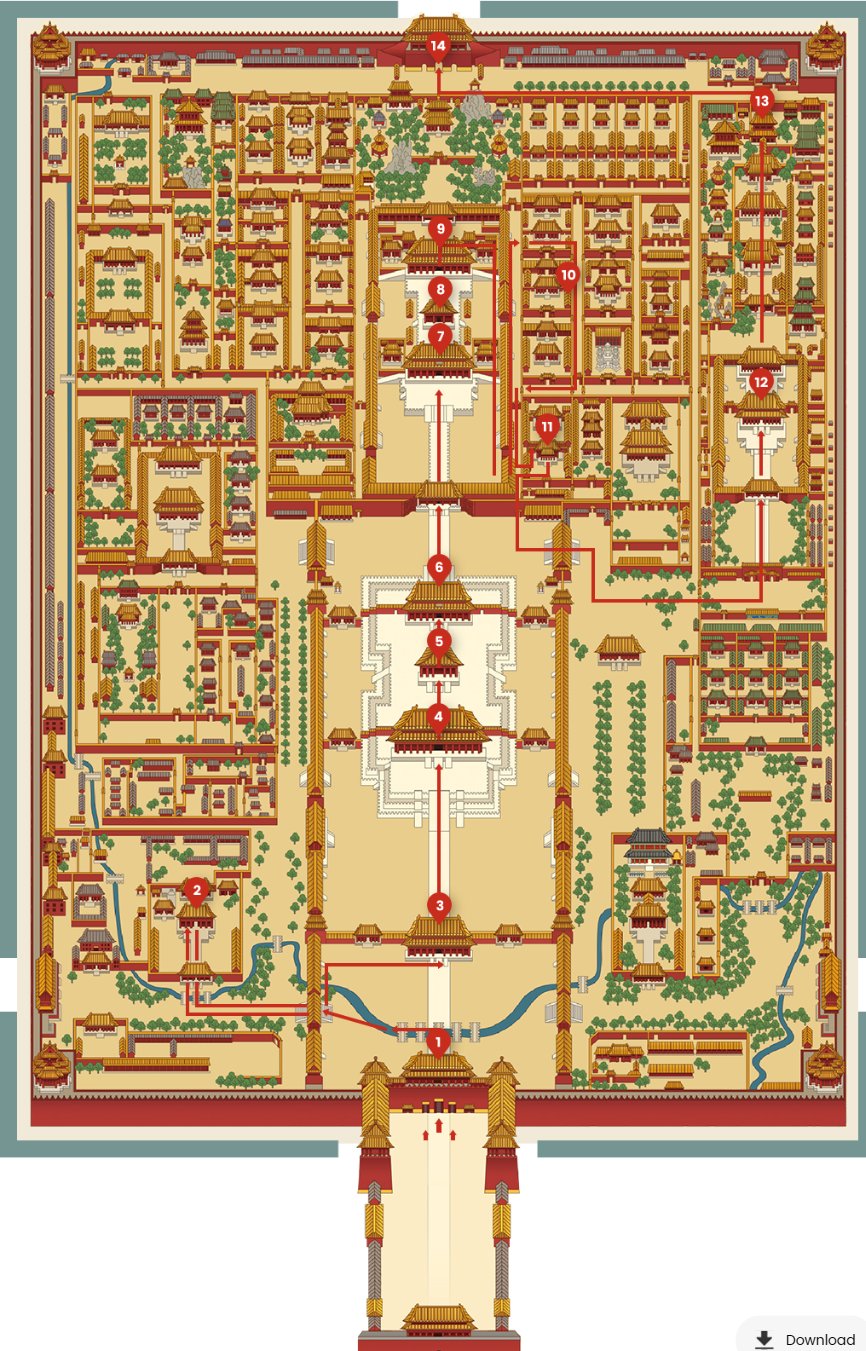
Adds the Wuying Hall ceramics gallery and the Western Six Palaces to the central axis. For most first-time visitors this is the right amount of palace — you get the imperial scale, the back garden and one of the best gallery collections in the country, without wearing yourself out. Stops 1 and 3–13 are the same as Route A — refer back for details. Only the stops unique to this route:
- 武英殿 Wuying Hall — turn left after entering. The ceramics gallery, in the oldest surviving hall of the complex (1407). Calm, uncrowded, a good place to start.
- 西六宫 Western Six Palaces (11–12) — consort residences west of the central axis. The interiors vary — some restored to look as they did under Qianlong, others left bare. The scale drops sharply from state architecture to domestic; you finally see how enclosed imperial women's lives actually were.
- 神武门 Gate of Divine Prowess (14) — same exit as Route A, into Jingshan Park.
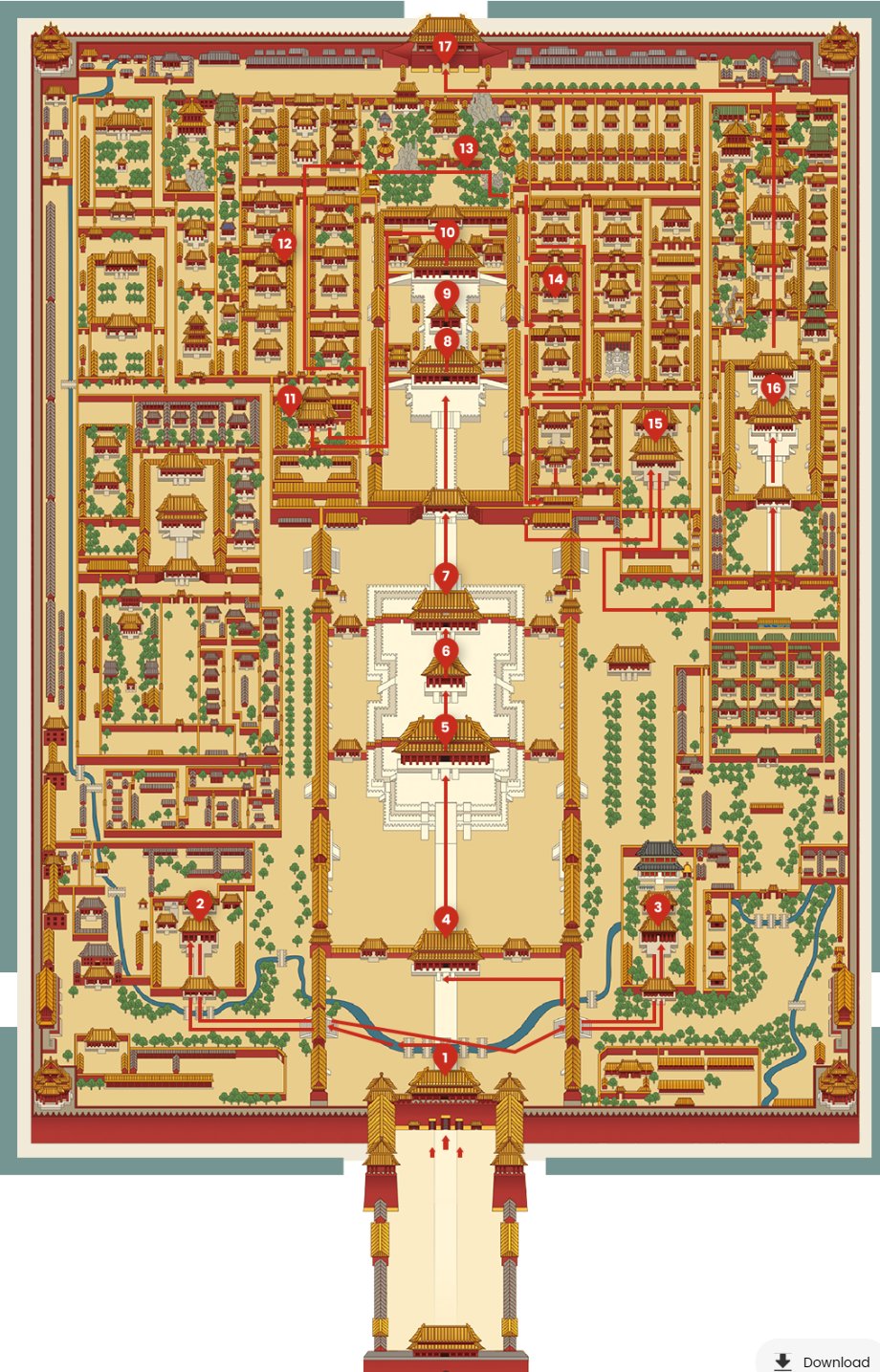
🏛️ Route C — Full Day (Both Side Wings)
The full coverage. Adds the eastern palace complexes on top of Route B — the rotating exhibitions and every major museum inside the palace walls. Only worth doing if you have a serious interest in Chinese art or architecture. Stops 4–13 are the same as Route A. Only the stops unique to this route:
- 武英殿 Wuying Hall — west side, ceramics gallery. Same as Route B; the strongest reason to come to this part of the palace.
- 文华殿 Wenhua Hall — east-side mirror of Wuying; the painting and calligraphy gallery. If you have time for only one gallery on a full day, make it this one.
- 西六宫 Western Six Palaces (14) — consort residences, west side. Same as Route B.
- 东六宫 Eastern Six Palaces (15) — consort residences, east side. Mirrors the western wing; mostly empty shells today but architecture intact.
- 神武门 Gate of Divine Prowess (17) — same exit as Route A, into Jingshan Park.
💡 Tip: On any route, the Treasure Gallery (珍宝馆) and Clock Gallery (钟表馆) are worth their ¥10 each — pick them up as a side loop off the central axis on Routes A or B, or stretch into Route C. The Treasure Gallery is, per yuan, the best museum value in China.
👟 Practical Tips
- Please set your navigation to "The Palace Museum — Wumen Gate (午门)." This is the only entrance to the Palace Museum; if you just set your destination to "The Palace Museum," you may be directed to the wrong location.
- Half-day is enough for most people. 3–4 hours covers the essentials. History buffs can easily spend 6–8 hours.
- Wear comfortable shoes. You'll walk 10,000+ steps; there are no shortcuts through the central axis.
- Photography is allowed outdoors everywhere. Flash photography is restricted in some gallery spaces.
- Combine with Jingshan Park (¥2 entry, 5-minute walk from the north exit) for the postcard view of the whole complex.
🏯 What You Are Actually Walking Through
The complex covers 72 hectares (180 acres) and contains 980 surviving buildings, the largest wooden architectural ensemble in the world. That number alone is hard to absorb — walking from south to north, you'll cover about 1.6 km, pass through seven main gates, and cross an elevation drop of 2 meters between the front hall and the back garden (a quiet Feng Shui reminder that the emperor ruled all). Here are the details first-time visitors routinely miss:
-
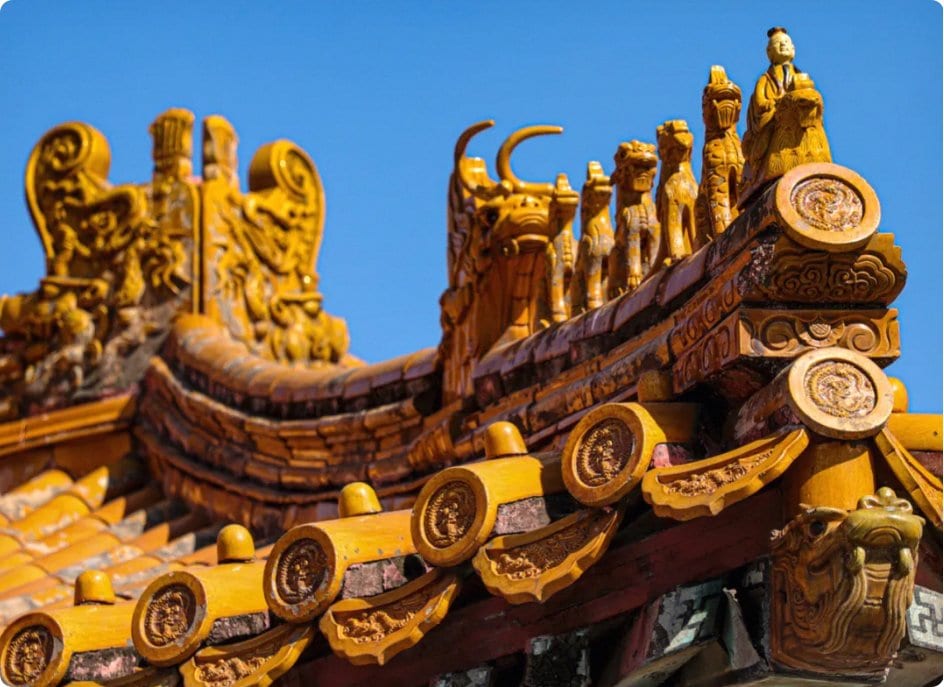
🟡The yellow tiles & ridge beasts. Every roof is glazed in imperial yellow — reserved for the emperor alone. Along the eaves sits a line of mythical beasts; the Hall of Supreme Harmony alone gets the full set of ten.
-
🐉The "10,000 dragon" carvings. Marble balustrades near the Hall of Supreme Harmony — nine dragons = imperial, ten = the Dragon Throne alone.
-
🦁The lions under each gate. Male (paw on ball, ruling the world) and female (paw on cub, raising the family). Some pairs are 600+ years old.
-
☁️The cloud-and-dragon stone doorways. The most elaborate one, behind the Hall of Preserving Harmony, took 12 craftsmen 2 years to finish.
-
🌳The Imperial Garden (御花园). The back of the complex, less crowded than the main halls. Rockeries shaped as mountains; pines over 400 years old.
🚫 Three Things You Should Not Skip
- The Hall of Supreme Harmony (太和殿) — the largest wooden structure in China. The throne sits in the middle. The bronze turtles and cranes in front of it were incense burners — the smoke was meant to purify the air symbolically before imperial audiences.
- The Treasure Gallery (珍宝馆) — the ¥10 ticket is the best value-for-money of any museum in China. Hall of Supreme Harmony's original roof ridge beasts, the Qianlong-era gold and jade ceremonial weapons, the gold-leaf Buddhas brought back from Tibet in the 18th century. Allow 45 minutes minimum.
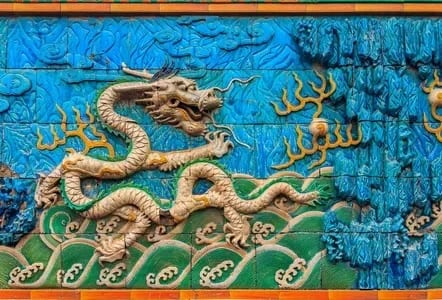
A glazed dragon on the Nine Dragon Wall, inside the Treasure Gallery complex. - The Palace of Heavenly Purity (乾清宫) — the emperors' residence through the Ming and into the early Qing. The central plaque above the throne (正大光明, "bright and upright") was written personally by each new Qing emperor. The "thirteen princes" plaques on either side are engraved instructions for imperial conduct.
Sources
- 1. Palace Museum Official Ticket Policy (故宫博物院票务政策) — intl.dpm.org.cn
- 2. Palace Museum Online Booking (故宫博物院在线订票) — bookingticket.dpm.org.cn
- 3. CCTV report on 2026 holiday and Forbidden City free opening — news.cctv.com